
TransUnion’s Annual Credit Perception Index Shows Improved Willingness Among Filipinos To Embrace Credit Amid Financial Uncertainty
- The 2024 Credit Perception Index for the Philippines stands at 69 out of 100 – jumping four points from last year
- The improvement reflects greater concept and product knowledge, trust, and favorability in credit products among Filipinos
- Negative associations surrounding credit are decreasing as concerns shift towards safety and security
Manila, Philippines, July 26, 2024 – Global information and insights company and the Philippines’ first comprehensive private credit reference agency, TransUnion (NYSE: TRU), released its second annual Credit Perception Index (CPI) today, which examines Filipino perceptions towards credit, factors contributing to those perceptions, and broader implications for the nation as a whole. The study aims to inspire meaningful dialogues and actions to improve credit literacy and financial inclusion at large for the Philippines.
The TransUnion CPI for the Philippines currently stands at 69 – an increase of four points from last year. The increase reflects improved concept knowledge, product knowledge, trust and favorability in credit products among Filipinos1.
This year’s study finds that most Filipinos (70%) have a general understanding of the concept of credit. Across credit products, Filipinos are most knowledgeable in installment payments (82%), followed by credit cards (76%), and buy now pay later (BNPL) services (74%). A five percentage points increase in knowledge is observed in both credit cards and BNPL. These two products also recorded a jump of six and three percentage points from last year in terms of trustworthiness – standing at 76% and 74% respectively, after only installment payments (80%). Moreover, BNPL (74%) and credit cards (72%) are growing in favor among the general population too, rising five and nine percentage points from 2023.
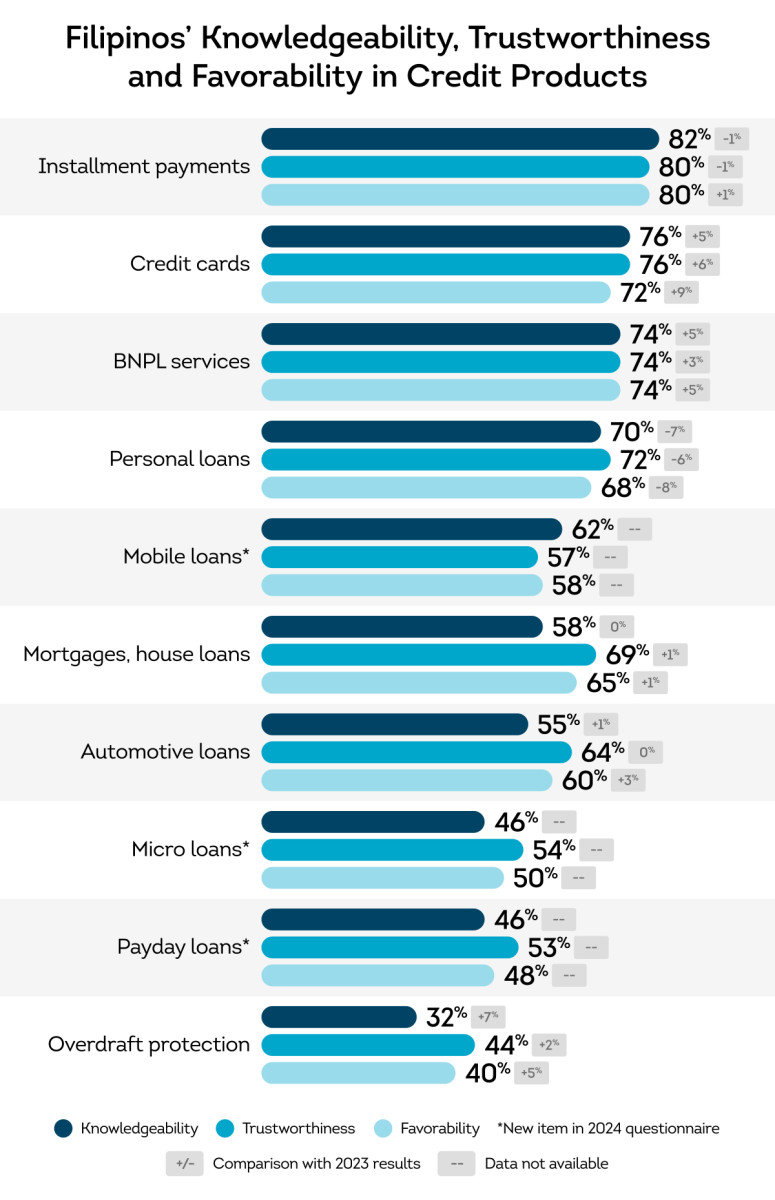
Despite these improvements, knowledge gaps still exist between the unbanked population and other populations. Currently, only 54% of unbanked Filipinos are knowledgeable about credit – a 16 percentage point deficit compared to the general population, and a 29 percentage point gap versus professionals from the financial technology (FinTech) sector. This represents a widening of the knowledge divide, as the disparity between the general and unbanked populations was at a smaller 11 percentage points last year.
Increasing adoption of credit products in the face of financial uncertainty
Financial sentiment among Filipinos appears to be less optimistic this year. Close to two fifths (38%) of the general population estimate their total wealth to be at PHP 250,000 and below. Moreover, the majority (75%) of surveyed Filipinos also consider themselves to be at best lower middle class or below.
Fewer Filipinos are optimistic that their financial situations will improve in the next year (84%) – dropping six percentage points from 2023. The study also reflects decreases in the number of Filipinos who expect their household income to increase next year (74%) and among those who can easily afford their daily necessities (68%), representing declines of nine and four percentage points respectively.
Unbanked Filipinos are struggling the most with the current situation. Almost three quarters (71%) often find themselves with limited money at the end of the month – a stark contrast to findings from both the general population (62%) and those in the FinTech sector (46%).
Despite these uncertainties, there is a noticeable shift towards diversifying financial tools with significant increases in owning credit-based products and bank accounts. Both credit cards (40%) and personal loans (25%) show increases of 15 and four percentage points from last year, while debit cards (52%), savings accounts (75%), and virtual bank accounts (29%) reflect increases of 12, 11, and nine percentage points, respectively. The majority of Filipinos (70%) also expressed a willingness to explore the usage of digital products and FinTech services in the next 12 months.
“The improved 2024 CPI score of the Filipino population is a product of collective efforts to foster greater financial literacy and inclusion. Despite financial uncertainties, we are delighted to see Filipinos proactively seeking ways to better manage their finances and unlock economic opportunities through responsible credit use,” said Weihan Sun, Principal of Research and Consulting for Asia Pacific at TransUnion. “However, disparities in credit knowledge still exist. Continued efforts are needed to further expand access and services to unbanked Filipinos, enabling them to realize the benefits of being financially included.”
Credit perceptions shift as safety and security emerge as top concerns
The study also found decreases in agreement with negative descriptions and sentiments towards credit products. More people now see credit cards as convenient (38%) and BNPL as helpful (47%) – increases of six and four percentage points from last year, respectively. Fewer people also believe that using credit products leads to overspending (52%) – dropping five percentage points from 2023.
However, while fewer Filipinos associate credit cards with being risky (16%, a drop of 10 percentage points from 2023), 46% of them are concerned with being scammed while using credit products. Among segments of the population, over half of both the general (56%) and unbanked population (50%) express concerns about scams and fraud.
To further build trust in credit products, financial institutions must prioritize transparency, address security concerns, and establish a strong reputation. Almost a quarter (22%) of Filipinos prefer more information about products such as clear terms and conditions and transparency on hidden charges, 19% want enhanced security and reliability measures such as automated threat detection and incident response, while 16% consider the established reputation and trustworthiness of an institution.
“Upward trends in credit knowledge, product preferences, consumer trust as well as favorability provide huge opportunities for lenders. As consumers are growing more aware and receptive towards credit products and usage, the formal financial sector must undertake trust-building efforts to continue to shift perception towards credit as an empowering force in the lives of Filipinos,” said Yogesh Daware, Chief Commercial Officer at TransUnion Philippines. “By doing so, further financial inclusion can be made possible in the country and driving overall national development.”
About the TransUnion Credit Perception Index
The TransUnion Credit Perception Index (CPI) study comprised of a survey targeting 1,000 consumers of the general population, as well as an oversample of 200 FinTech professionals between March to April 2024. To gauge Filipino’s current attitudes and future receptivity towards credit, respondents were posed a series of questions to rate their knowledge, trust and favorability surrounding credit and other financial products. The study aims to provide a holistic view of credit perceptions across the landscape and gain further insights to address gaps surrounding public perceptions of credit, what may influence them, and what may shift their perceptions. CPI will be conducted annually to monitor changes prevailing Filipino credit attitudes and perceptions over time.
For more information and insights, please view the full report of the TransUnion Credit Perception Index study.
1Concept knowledge refers to the general understanding of credit as the ability to acquire goods or services with payment to be made later. Product knowledge refers to awareness of credit-based products such as credit cards, loans, and installment payments. Trust and favorability pertain to credit perceptions and the credit products respondents are more inclined to using.
